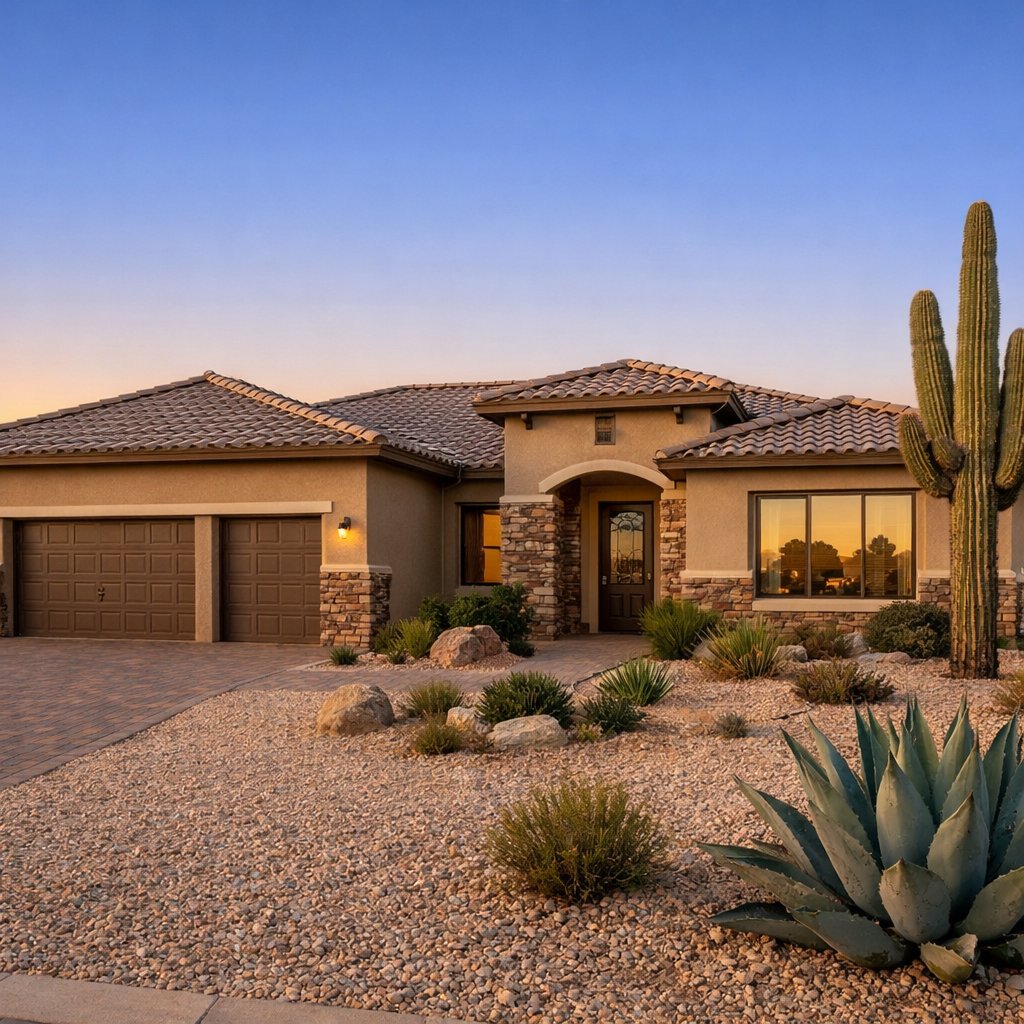
You are standing in the backyard of a home you like in Litchfield Park on a warm Tuesday evening, and then you hear it — a low, building roar as a fighter jet climbs out of Luke Air Force Base a few miles away. Some buyers barely notice it after a week. Others decide on the spot that it is not for them. Either reaction is fine. What is not fine is finding out about the flight path after you already own the house.
If you are shopping the West Valley — Glendale, Litchfield Park, Waddell, El Mirage, Surprise, Goodyear, or the western edge of Peoria — there is a real chance the home you are considering sits inside what Arizona calls the "territory in the vicinity" of Luke Air Force Base. That is not a reason to avoid an area. It is a reason to go in with your eyes open. This guide walks through where "near Luke" actually is, what the noise and safety zones mean, what Arizona law requires sellers to tell you, and the exact steps to check a specific address before you fall in love with it.
Where "near Luke" actually is
Luke Air Force Base sits on the west side of the Valley near Glendale, Litchfield Park, and Waddell. It is a pilot-training base, so jets fly frequently during training windows, and the aircraft you hear today can be different from what flew a decade ago as the mission changes over time.
Arizona law draws a specific boundary around military airports. Under state statute, the "territory in the vicinity" of Luke extends roughly ten miles to the north, south, and west, and four miles to the east, measured from the center of the main runway (A.R.S. § 28-8461). That is a large footprint. It reaches well beyond the fence line and touches parts of several West Valley cities. A home ten miles out will experience the base very differently from one two miles off the departure end of the runway — but both can fall inside the disclosure zone.
The takeaway: "near the base" is not one thing. Proximity, which direction the home sits relative to the runway, and whether it falls in a mapped noise or safety zone all matter, and they matter differently from address to address.
What the jet noise actually means, day to day
The military measures aircraft noise using something called the Day-Night Average Sound Level, or DNL, and maps it in contour lines. Around Luke, the published Air Installation Compatible Use Zone (AICUZ) contours generally run from 65 DNL on the outer edge up to 80 DNL closer in, according to the Air Force's own materials (luke.af.mil). The higher the number, the more consistent and louder the noise exposure.
A few honest things to understand about that:
- DNL is an average, not a peak. An individual flyover can be much louder than the "average" number suggests. The contour tells you about overall exposure, not what a single jet sounds like on a busy afternoon.
- Noise is not constant. Training happens in windows, and there are quieter stretches. The only way to really know is to visit the specific home at different times of day and week.
- Some homes fall in an Accident Potential Zone (APZ). These are areas off the ends of the runway where the military maps a higher statistical risk and recommends land-use limits. APZs are separate from noise contours and can affect what a property can be used for.
None of this is meant to scare you. Plenty of people live comfortably in the West Valley within earshot of Luke and would not trade it. The point is to replace a vague worry with specific information for the specific home you are considering.
Arizona's military airport disclosure law
Arizona is one of the states that takes this seriously in writing. Under A.R.S. § 28-8484, a seller of residential property that sits within the mapped territory in the vicinity of a military airport must give the buyer a written disclosure before title transfers. The boundaries come from maps prepared at the state level, and the Arizona Department of Real Estate publishes airport boundary maps the public can view (azre.gov).
There is also a construction rule worth knowing: Arizona has restricted new residential construction inside the highest noise contour (generally the 65 DNL line) for homes that were not already established before the early 2000s. In practice that means much of the housing inside the tightest contours is older, and newer subdivisions tend to sit farther out — but you should never assume. Confirm the specific parcel rather than guessing from the year the neighborhood looks like it was built.
Because statutes, maps, and boundaries can be updated over time, treat this section as a starting point and verify the current requirements and maps for the exact property you are considering with the appropriate agency and your own professionals.
How to check a specific address before you write an offer
This is the part that actually protects you. Before you get emotionally attached to a home in the corridor, run this checklist:
- Pull the address on the state's military airport maps. Start with the Arizona Department of Real Estate airport boundary maps (azre.gov) to see whether the parcel falls inside the vicinity boundary, a noise contour, or an accident potential zone.
- Ask for the military airport disclosure in writing. If the property is in the mapped area, the written disclosure is required — read it, do not just sign it. Ask questions about anything you do not understand.
- Visit the home more than once, at different times. Go on a weekday afternoon and again in the evening or on a weekend. Stand in the backyard. Open the windows. Decide how it actually feels to you.
- Ask your lender and insurer specifically about the location. Loan programs and insurance can have their own considerations near a base and inside certain zones. Get answers in writing before you remove contingencies.
- Confirm any use or building restrictions. If a home is in an APZ or a high-noise contour, ask what that means for additions, rebuilds after a loss, or future changes.
- Loop in a local agent who works this corridor. Someone who sells in the West Valley regularly can tell you how buyers in that specific pocket tend to react, which matters for your own resale later.
Because prices, inventory, zone boundaries, insurance, and lending guidelines can change, verify the details for the specific property you are considering rather than relying on general information.
What the flight path can mean for value and resale
Buyers always ask the same underlying question: will being near Luke hurt me when I sell? The honest answer is that it depends on the home, the price, and the pool of buyers who want that area — and no one can guarantee how any specific property will perform.
What is fair to say is this. A share of buyers will filter out anything in the flight corridor, and a share will not care at all, and some will actively prefer the shorter commute to the base. Homes inside the corridor sell every day in the West Valley. Pricing and presentation tend to do more of the heavy lifting there than they do in a quieter pocket, because the buyer pool is a little more self-selected. If you buy well and the home is priced right for its location, that same logic works in your favor when it is your turn to sell.
Avoid two mistakes. Do not assume a home near the base is automatically a bargain — the discount, if any, is already priced in by the market. And do not assume it is automatically a problem — for the right buyer at the right price, it is simply a tradeoff they happily accept.
A realistic West Valley example
Consider a couple relocating to the West Valley who found two homes they liked equally at first glance. One sat in Litchfield Park, a couple of miles off the departure end of the runway, inside a mapped noise contour. The other was farther west in Surprise, outside the tightest contours. The Litchfield Park home offered more square footage and a bigger lot for the same money — the classic corridor tradeoff.
Instead of guessing, they pulled both addresses on the state maps, read the written disclosure on the Litchfield Park home, and visited it twice — once midday and once on a Saturday. The noise was noticeable but livable to them, and the extra space mattered. They wrote on the Litchfield Park home with clear eyes, negotiated on price knowing the location, and asked their insurer about the area up front. The point is not which house was "better." It is that they made an informed choice instead of an emotional one, and they will be able to explain that same tradeoff to their own buyer someday.
Making a confident decision
Living near Luke is a genuine tradeoff, not a dealbreaker and not a free lunch. The buyers who are happiest with their choice are the ones who checked the maps, read the disclosure, visited the home more than once, and priced the location honestly into their offer. Do those four things and you can decide from a place of confidence rather than second-guessing yourself later.
Ready to compare your options? Schedule a friendly consultation with Stephanie White, REALTOR® (Howe Realty), so you can build a simple, step-by-step plan for your next move in the West Valley.
Frequently asked questions
How close to Luke Air Force Base is "too close"?
There is no single answer, because it depends on your own tolerance for noise and the specific home. Arizona maps a "territory in the vicinity" that reaches about ten miles north, south, and west and four miles east of the main runway, but experience varies enormously across that area. The best test is to visit the specific property at different times and check where it falls on the state's noise and accident-potential maps.
Does Arizona law require sellers to tell me a home is near a military base?
Yes, when the property falls within the mapped territory in the vicinity of a military airport. Under A.R.S. § 28-8484, the seller must provide a written disclosure before title transfers. Read it carefully and ask questions — do not treat it as just another signature.
Where can I see the noise and accident zones for a specific address?
The Arizona Department of Real Estate publishes military airport boundary maps for the public (azre.gov). You can use them to see whether a parcel falls inside the vicinity boundary, a noise contour, or an accident potential zone. Because boundaries can be updated, confirm the current map for the exact property.
Will buying near Luke hurt my resale value?
No one can guarantee how any specific home will perform. Some buyers filter out the corridor entirely and some do not mind it, so pricing and presentation carry more weight there. Homes in the area sell regularly; buying at the right price for the location is what protects you at resale.
Can I build a new home or add on inside a noise contour?
Possibly, but there are restrictions. Arizona has limited new residential construction inside the highest noise contour, and homes in an accident potential zone may face additional land-use limits. Confirm what is allowed for the specific parcel before you count on an addition or a rebuild.
Is the noise constant, or only during certain hours?
It is not constant. Luke is a training base, so flying happens in windows with quieter stretches in between, and the mission can change over time. The only reliable way to know how a particular home feels is to visit it on more than one day and time.
Which West Valley cities are affected?
Depending on distance and direction from the runway, parts of Glendale, Litchfield Park, Waddell, El Mirage, Surprise, Goodyear, Avondale, and the western edge of Peoria can fall within the mapped vicinity. Whether a specific home is affected is an address-by-address question, not a city-wide one.
