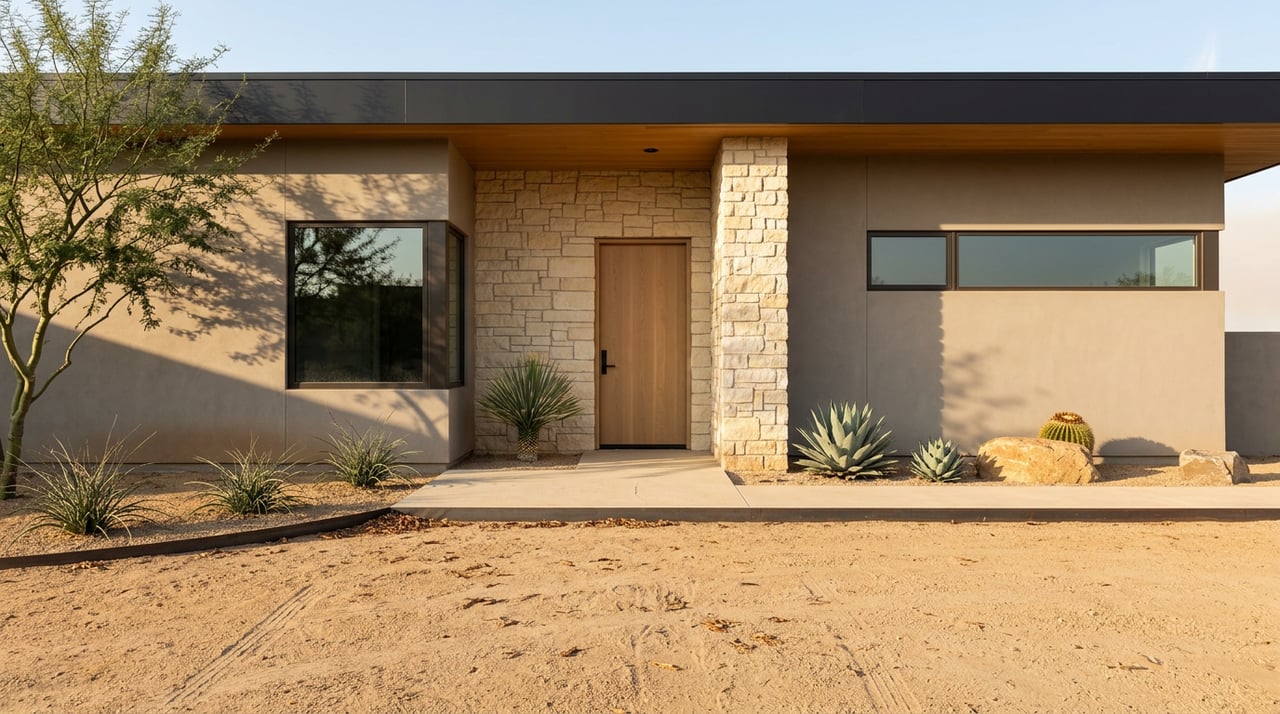
Two homes can share a Cave Creek 85331 address, sit ten minutes apart, and require two entirely different inspection budgets, contingency structures, and insurance conversations. The line that separates them is not price. It is whether the property sits inside the municipal water and sewer footprint or outside it.
That single fact reshapes the offer you should write, the contingencies you should refuse to waive, and the timeline you should ask for. In a market where the June 2026 pending group moved in a median of 24 days, knowing which transaction you are running before you write the offer is the difference between a clean close and a surprise at day 18.
The map you are actually shopping on
Cave Creek covers about 37.7 square miles and behaves like several markets stacked under one ZIP code. Tatum Ranch, Dove Valley Ranch, and Rancho Mañana sit on municipal water and sewer. Lone Mountain, the Carefree Foothills edge, Spur Cross-adjacent acreage, and most horse-zoned parcels north of Carefree Highway typically operate on private wells and septic systems. Same town, same schools, same MLS, categorically different closings.
| Diligence item | Municipal-utility core (Tatum Ranch, Dove Valley, Rancho Mañana) | Rural acreage (Lone Mountain, foothills, Spur Cross-adjacent) |
|---|---|---|
| Water source | Town/municipal | Private well, sometimes shared |
| Wastewater | Municipal sewer | Septic tank and drain field |
| Road access | Public, paved | Often private, sometimes unpaved |
| Easements to verify | Standard title | Access easements, shared-well agreements, road maintenance |
| Insurance driver | Standard homeowner | Wildfire interface with the Tonto National Forest |
| Typical price band | $255K–$345K at Terra Vista; SFR into the $600Ks–$900Ks | $850K to $4M+, with acreage estates well above |
If your search is bouncing between a Terra Vista condo and a five-acre parcel off Spur Cross Road, you are not shopping one market. You are shopping two.
What the June numbers say about your leverage
The 12-month trailing median sale price in Cave Creek sat around $825,000 as of spring 2026, roughly 1% above the prior year, with a current median list of $1.15M to $1.18M and an average single-family sale near $1.03M. Days on market ran 69 to 111 depending on segment, and the sale-to-list ratio held between 94% and 98%. In June 2026, the median estimated property value was about $849,280 and new pendings were moving in a median of 24 days at a $912,500 median list.
Read those together. The pending pool moves quickly because well-priced homes attract the serious buyers who have been watching the market. Everything else sits. That gap is your leverage. On homes past the 45-day mark, sellers are usually open to the terms that protect you most: full inspection windows, well and septic contingencies written in, and financing timelines that do not force you to skip a lab result.
The trap is that a fast pending median can pressure buyers into shortening the wrong things. Shorten the appraisal window if you must. Do not shorten a well yield test.
The well items that actually end deals
A private well in Cave Creek is either an asset you control or a maintenance obligation you inherit. The difference is what shows up in the reports. On any well-served property, the diligence file should include:
- A well pump yield test with recorded gallons-per-minute flow, ideally over a sustained draw rather than a single-minute reading
- Water quality testing for bacteria, nitrates, arsenic, and total dissolved solids, with results in writing before your inspection period closes
- Well log documentation showing depth, casing, and installation date, pulled from the Arizona Department of Water Resources well registry at new.azwater.gov
- A written shared-well agreement if the well serves more than one parcel, recorded against title, with cost-sharing and repair authority spelled out
- Pump, pressure tank, and controller age, since replacement of a constant-pressure system runs into real money and often surfaces as a post-close surprise
A well that flows fine in April can struggle in a dry September. Ask your inspector what they saw in the surrounding basin over the last twelve months, not just what the meter said the morning of the test.
The septic items that end deals
Septic diligence is where inexperienced buyers most often waive the wrong contingency. A visual pass is not an inspection. On any septic-served property, the file should contain:
- A full tank pump and interior inspection, not just a lid lift
- A drain field performance evaluation, since a failed leach field is the expensive failure mode, not the tank itself
- A camera sewer line inspection from house to tank
- Confirmation of tank capacity relative to bedroom count, which matters if you plan to add square footage or a casita
- Records of the last pump-out, with local specialists like Cave Creek Septic Service recommending a four-year pump interval and annual effluent filter cleaning
Arizona requires a transfer inspection on most septic systems within six months of closing, filed through the county. Sellers who have already completed the report save the buyer time and remove a common last-week scramble.
Easements, roads, and the wildfire line on your insurance quote
Three items that look small on paper and get large at closing:
Recorded easements. On acreage, legal access is not the same as the driveway you drove in on. Pull the title commitment, read the easement exhibits, and match them to the survey. If a neighbor's access crosses your parcel, or yours crosses theirs, get the maintenance terms in writing before you release contingencies.
Private road maintenance. Many north-of-Carefree-Highway parcels sit on private roads with informal maintenance histories. Ask for the written agreement. If there isn't one, ask why. That is a negotiation point, not a deal killer, but it belongs on the table before you sign.
Wildfire and insurance. Properties in the Tonto National Forest interface carry wildfire exposure, and insurers price that in. Get a bindable quote during your inspection period, not the week before close. Defensible space work, roof material, and vent screening all affect the premium. The Arizona Department of Forestry and Fire Management publishes defensible space guidance at dffm.az.gov that lenders and insurers increasingly reference.
For sellers reading this: the disclosure move that actually helps
If you are listing a rural Cave Creek property in this market, the play is to front-load the paperwork. A pre-listing well yield test, a recent septic pump and inspection report, a copy of the shared-well agreement, a road maintenance agreement, and a current wildfire mitigation summary do more for your sale-to-list ratio than a price cut. Buyers in the 94% to 98% sale-to-list band are paying for confidence. Give them the file and they stop asking for concessions to cover unknowns.
Sellers who price to the recent comparable set and hand over a complete diligence packet on day one are the ones closing at the top of that ratio. Sellers who test high and reduce twice are the ones ending up at 92%.
A realistic diligence timeline when pendings move in 24 days
If you are writing an offer on a home that just hit the market, here is a workable sequence inside a standard ten-day inspection period:
- Day 1: Order the general home inspection, well pump yield test, water quality lab, septic tank and drain field inspection, and camera sewer scope in a single call. Vendors book out; get on the calendar first.
- Day 2–3: Pull the title commitment. Read every easement exhibit against the survey. Flag anything unclear in writing.
- Day 4–5: Inspections happen on site. Ask to attend the well and septic portions in person.
- Day 6–7: Lab results land. Bindable insurance quote comes back. Compare the wildfire premium to your budget.
- Day 8: Sit with your agent. Decide what is a repair request, what is a credit request, and what is a walk-away.
- Day 9: Deliver the BINSR or equivalent in writing.
- Day 10: Negotiate, extend, or release.
The sequence looks tight because it is. It is also entirely doable when the vendors are booked on day one instead of day four.
FAQ
Do all Cave Creek properties have wells and septic?
No. Tatum Ranch, Dove Valley Ranch, and Rancho Mañana are generally on municipal water and sewer. Lone Mountain, Carefree Foothills, and most acreage parcels north of Carefree Highway typically use private wells and septic. Confirm on the specific parcel, not the ZIP code.
Can I get a conventional loan on a well-and-septic property?
Yes, though appraisers on custom acreage sometimes struggle to find comparable sales, which can produce an appraisal below contract. Plan for that possibility with a larger down payment cushion or an appraisal contingency you are prepared to use.
How long is a well yield test valid?
Most lenders and insurers want results dated within the last six months. If the seller's test is older, order your own.
What does a septic transfer inspection actually cover?
Tank condition, effluent levels, baffle integrity, drain field performance, and capacity relative to the home's bedroom count. It is a specific document with a specific format, not a general home inspector's checkbox.
If you are writing an offer on a Cave Creek property this month and the diligence list above raised more questions than it answered, that is the right time to talk. Stephanie White works these transactions from offer through close and can tell you within one call which of the two Cave Creek transactions you are actually running. Schedule a consultation and bring the address.
