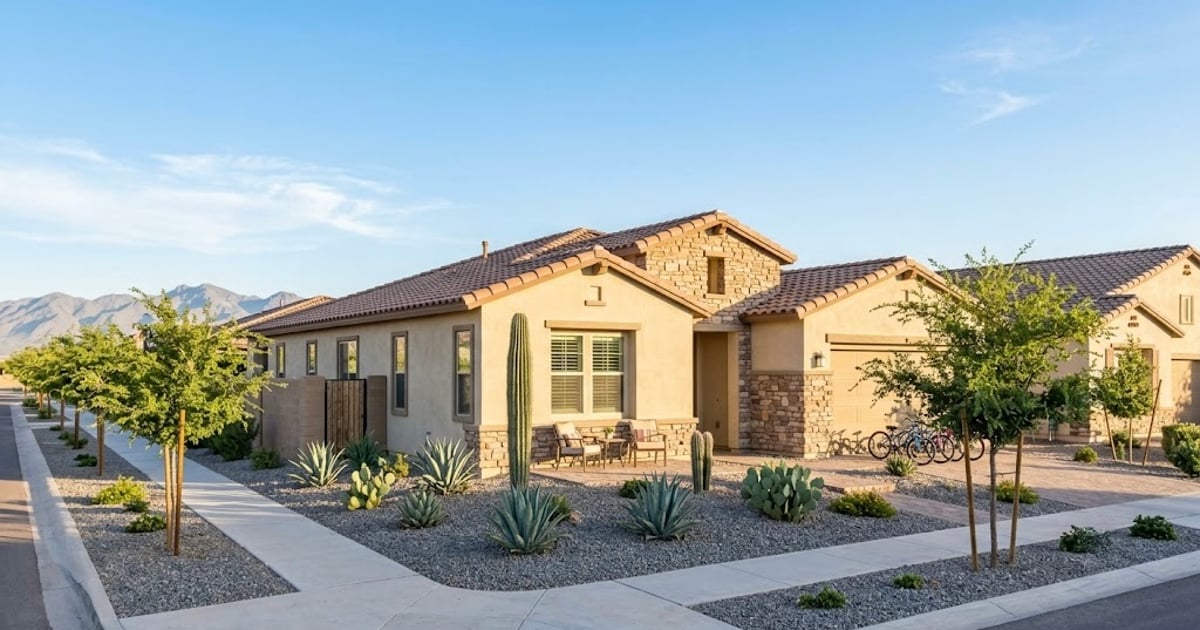
You are standing in the driveway of a home you could see yourself in. Stone-and-stucco front, mountain view down the street, a guard house you passed on the way in. It feels like a step up from where you are now. Then the questions start. Do I have to join the golf club? What is the gate actually doing? Why is the HOA number on this one so much higher than the house we looked at last weekend?
Those are the right questions to ask, and most move-up buyers in the North Valley ask them too late, usually after they are already emotionally attached to the house. A gated or golf community can be a genuinely great fit for how you want to live. It can also come with cost layers that never show up on the listing sheet. This guide walks through how these communities really work here in North Peoria and the surrounding West Valley, so the numbers and the lifestyle both make sense before you write an offer.
Gated, guard-gated, and "golf community" are three different things
People use these terms interchangeably, and they are not the same. Sorting them out is the first step to knowing what you are buying.
Gated vs. guard-gated
A gated community controls vehicle access with a gate, usually a resident code or clicker plus a call box for visitors. A guard-gated community adds a staffed gate house, sometimes 24 hours, sometimes limited hours with roving patrol the rest of the day. Guard-gated typically means higher HOA dues, because you are paying for staffing. Neither arrangement is a statement about a neighborhood's character. It is an access and privacy feature, the same way a pool or a trail system is a feature. Ask specifically how the gate is staffed and what hours, because "gated" on a listing can mean anything from a simple arm gate to a full manned entry.
What "golf community" actually means
A golf community is a neighborhood built around a course. That does not automatically mean you golf, and it usually does not mean membership is included with the house. In most North Valley communities the golf club is a separate business from the HOA. You can own a home there, use the community pools and trails, and never set foot on the course. The course itself may be private (members and guests only) or open to the public. For example, within the Vistancia master plan in North Peoria, Blackstone is a private, gated golf community with the member-only Blackstone Country Club, while Trilogy is served by the Trilogy Golf Club, which is open to public play. Same master plan, two very different golf models.
The cost stack: what you actually pay, layer by layer
The single biggest surprise for move-up buyers is that the "HOA fee" is rarely one number. In master-planned and golf communities it can be several fees stacked together, plus taxes that are easy to miss. Here is the full stack to price out before you fall for the kitchen.
- Master / community association dues. The base HOA that funds the shared amenities, gates, and common-area landscaping.
- Sub-association or village dues. Large master plans like Vistancia are divided into villages and sub-associations, each with its own dues on top of the master fee. A home in a gated sub-section often carries an extra layer the community across the street does not.
- Golf or club membership. If you want to play a private course, membership is usually separate and can involve an initiation or equity deposit plus monthly dues. Some clubs offer social memberships (pool, dining, fitness) without full golf. Confirm whether any membership is mandatory or optional for your specific home, because a small number of communities require it.
- Special-district (CFD) property taxes. Many newer West Valley master-planned communities were built using Community Facilities Districts, which repay infrastructure through an assessment on your property tax bill. This can make two similar homes have noticeably different tax bills based only on which community they sit in. It is not hidden, but you have to look for it on the parcel's tax record.
- Capitalization and transfer fees at closing. Many HOAs charge a one-time working-capital or transfer fee when the home changes hands. It shows up on your settlement statement, not the listing.
None of these are reasons to avoid a gated or golf community. They are simply the true price of entry, and you want the full picture before you compare one home to another. Because HOA dues, club fees, CFD assessments, and taxes can change, verify the current figures for the specific property and community you are considering rather than relying on last year's numbers.
What you are really buying: the lifestyle side
Cost is only half the decision. The other half is whether the way these communities are built matches how you actually live.
- Amenities you will use, honestly. Resort pools, fitness centers, tennis and pickleball, miles of walking trails, and event calendars are common in the larger North Valley master plans. They are worth real money, but only if you use them. Be honest about which ones you will actually touch in a normal month.
- Lock-and-leave living. Gated communities with maintained common areas are popular with buyers who travel or spend summers elsewhere, because the exterior and security load is lighter to manage.
- View and premium lots. In communities like WestWing Mountain and the gated Sanctuary section, lots that back to preserve or open desert usually command a premium and tend to hold interest at resale. A view lot in a gated section is often the most competitive home in the neighborhood.
- Rules that protect the look, and limit you. The same design and landscape standards that keep a community polished also govern what you can change. If you plan to add an extended patio, an RV gate, or a casita, read the CC&Rs first, not after.
- Rental and short-term-rental restrictions. If you ever want to rent the home, many communities cap or prohibit short-term rentals. Verify the current rule in writing.
A quick tour of the North Valley landscape
To make this concrete, here is how a few recognized local communities are structured. Details change, so treat this as orientation and confirm specifics per home.
Vistancia (North Peoria)
A large master plan off Lake Pleasant Parkway with multiple villages. It contains the private, guard-gated Blackstone golf community and the separate Trilogy community served by a public-access course. Expect a master association plus village or sub-association dues depending on where you land.
WestWing Mountain and Sanctuary at WestWing (North Peoria)
Established foothill neighborhoods anchored near Happy Valley Road, with a gated luxury section (Sanctuary) where preserve-backing and view lots are scarce and trade more on relationships than open-market volume.
Sterling Grove (Surprise)
A newer gated golf community along the Loop 303 corridor with a Toll Brothers presence and a club component. Note it sits in a different school district than the Peoria communities, so verify boundaries if that matters to you.
Farther-out options
Communities like Quintero sit well north of the core West Valley ring. They offer ultra-low-density golf living, but the trade-off is a longer drive to daily shopping, dining, and freeways. Drive it at the times you would actually commute before you decide the distance works.
Before you buy in a gated or golf community: a verification checklist
Run this list on any gated or golf-community home before you are under contract. Your agent and the HOA disclosure packet can source most of it.
- Total monthly carrying cost: master HOA + any sub-association + any mandatory club dues, added up.
- Is any membership mandatory for this specific home, or fully optional?
- Golf access model: private members-only, public, or semi-private, and what a membership costs if you want one.
- CFD or special-district assessment on the parcel's tax record, and how it compares to a non-CFD community.
- One-time fees at closing: capitalization, working capital, transfer, and disclosure fees.
- Reserve health: ask for the HOA's reserve study and recent budget so you know if a special assessment is likely.
- Gate details: staffed hours, guest access process, and delivery handling.
- CC&R limits on additions, exterior changes, RV or boat parking, and rentals.
- Pending changes: any planned dues increases, construction phases, or amenity projects.
A real-world example
Picture a couple in their mid-40s selling a home in central Peoria and moving up into North Peoria. They tour two homes in the same master plan. The first is a view lot inside a guard-gated golf section, priced higher, with a master fee, a village fee, and an optional club membership if they want the course. The second is a larger interior lot in a non-gated village nearby, more square footage for the money, with a single lower HOA fee and no club. Same community, very different monthly math and very different daily feel. Once they priced out the full carrying cost of each and were honest that neither of them golfs, the interior lot with the bigger yard made more sense, and they put the difference toward a backyard build. There is no universally right answer here. There is only the right answer for how you live and what you will use.
Ready to compare your options?
Gated and golf communities can be a fantastic move-up, as long as you are buying the lifestyle you actually want at a cost you have fully seen. If you are weighing a North Valley community and want help pricing out the real carrying cost and finding the homes that fit, schedule a friendly consultation with Stephanie White so you can build a simple, step-by-step plan for your next move.
Frequently asked questions
Do I have to join the golf club if I buy in a golf community?
Usually no. In most North Valley golf communities the club is a separate business from the HOA, and membership is optional. A small number of communities do require some form of membership, so confirm the rule for the specific home before you assume either way.
What is the difference between gated and guard-gated?
Gated means controlled vehicle access through a gate with resident codes and a visitor call box. Guard-gated adds a staffed gate house, which usually raises HOA dues because you are paying for staffing. Ask exactly how the entry is staffed and during what hours.
Are HOA fees always higher in gated and golf communities?
Often, yes, because you are funding more shared amenities, gates, and sometimes staffing. But the number can be several fees stacked together, so compare total monthly carrying cost rather than a single headline figure, and verify current amounts for the specific home.
What is a CFD, and why do two similar homes have different tax bills?
A Community Facilities District is a financing tool many newer West Valley master plans used to build infrastructure, repaid through an assessment on your property tax bill. Because of it, two comparable homes can carry different tax bills based only on which community they sit in. You can find it on the parcel's tax record.
Do gated communities hold their value better?
Gates, amenities, and premium view lots can support buyer demand, but no one can guarantee appreciation. Because prices and market conditions change, look at recent comparable sales in that specific community rather than assuming a gate alone protects value.
Can I use the home as a short-term rental?
Many gated and master-planned communities restrict or prohibit short-term rentals through their CC&Rs. If renting is part of your plan, get the current rule in writing before you buy.
Are communities like Trilogy age-restricted?
Some are. Trilogy at Vistancia, for example, is a deed-restricted age-qualified community, which is a legal characteristic of the community itself. If age-qualification matters to your plans in either direction, confirm the community's status before you tour.
