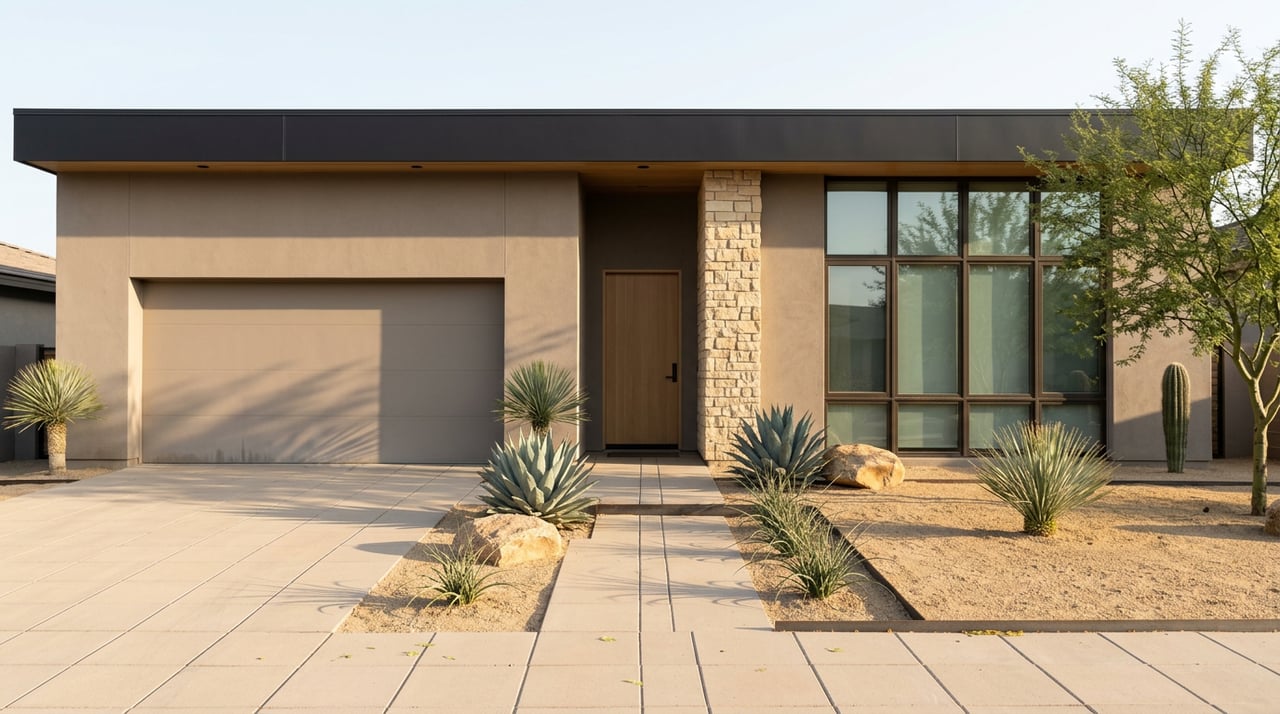
You walk into a sales office at Sterling Grove or Artisan at Asante, and the number on the model home sign hasn't moved much from what it was last spring. The sales rep hands you a rate that sounds too good to be true: something in the mid-4s when everyone you know is financing at 6.5 or higher. You leave thinking you found a deal. What you actually found is a builder protecting a number they can't afford to move: the price.
That distinction matters more than it sounds like it should, and it matters specifically in Surprise right now, where new construction and resale are behaving like two different markets wearing the same ZIP code.
Why the price stays put while everything around it moves
A builder selling in a master-planned community isn't pricing one house. They're pricing every house still on the lot, plus every appraisal that will lean on the last closed sale as a comp. If a builder cuts the price on a spec home to move it, that lower number becomes the new benchmark for the next appraisal in the same phase, and it can upset the buyer three doors down who closed last month at full price. A mortgage industry explainer on builder incentives lays out the logic plainly: a price cut "drags down the comparable sales that every remaining home is measured against," and lower comps can create appraisal problems down the line for homes still under contract.
So builders reach for a different lever. A rate buydown or a closing cost credit lowers what you pay every month without touching the number that shows up in the county recorder's file. You get relief. The builder's comp sheet stays intact. That's not a coincidence. It's the whole point.
This is why, as of July 2026, Surprise's single-family median sat at roughly $434,000, essentially flat from June's $432,000 print and up only modestly year over year, while builders across the market's major communities were widening incentives back toward spring peak levels. Rate buydowns and closing cost credits were reported at their highest availability of the year that month, alongside looser design center allowances. The price barely moved. The deal moved somewhere else entirely.
It's worth flagging that market trackers don't fully agree on how loose the market actually is. One July reading put days on market at 67 with 6.4 months of supply, a number that would suggest real buyer leverage. A separate tracker pulling June data put days on market closer to 89 with only 1.5 months of supply, a much tighter read. Different platforms pull from different snapshots and different definitions of active inventory. The practical takeaway isn't which number wins. It's that a single scraped statistic from a portal is a worse guide than a current pull from your own agent's MLS access, especially when you're trying to time an offer against builder incentive cycles.
What the incentive actually costs you later
A temporary rate buydown lowers your interest rate for the first one to three years before it reverts to the full note rate. That's a real benefit if you know your income is about to grow, or if you plan to refinance before the reversion hits. It's a real risk if you're budgeting off the year-one payment and forgetting that year three arrives with a bigger bill. Builder incentives are also frequently tied to using the builder's own preferred lender, which means the advertised rate needs to be checked against the true APR, not just the headline number, before you sign anything.
None of this makes new construction a bad option in Surprise. It makes it a different kind of math than comparing two resale listings against each other. And the piece of that math most buyers miss isn't the interest rate at all.
The line item resale buyers never see
Most of the large master-planned communities driving Surprise's new construction activity, including Asante and Sterling Grove, sit inside a Community Facilities District. A CFD is a special taxing district authorized under Arizona's Community Facilities District Act, in place since 1988, that lets a city let a developer finance roads, water and sewer lines, and drainage infrastructure through bonds. Those bonds don't stay with the developer forever. As the community builds out, responsibility for repaying that debt shifts to the homeowners who benefit from the infrastructure, and it shows up as its own line item under the Special District section of your Maricopa County property tax bill, separate from your standard county and school taxes.
A standard, older Surprise subdivision without a CFD typically runs HOA dues in the $70 to $150 a month range and nothing beyond ordinary property tax. Compare that to what sits inside the newer master plans:
| Community | Builder(s) | Typical HOA | Additional CFD assessment |
|---|---|---|---|
| Standard Surprise subdivision | Various | $70 to $150/month | None |
| Artisan at Asante | Lennar, Pulte, Taylor Morrison | Around $185/month | Roughly 0.50 percent on top of standard property tax |
| Heritage at Asante (55+) | Lennar | Around $231/month plus collection fees | Roughly 0.50 percent, same Asante CFD |
| Sterling Grove | Toll Brothers | Guard-gate and golf-club dues, structured separately | CFD applies within the master plan |
| Marley Park | Built out, mostly resale | Standard HOA | Its own dedicated Marley Park CFD, a separate taxing entity from the city |
Marley Park is a useful reminder that CFDs don't disappear once a community is finished. Originally entitled for closer to 3,800 homes, Marley Park is now built out at roughly 1,820 homes across 950 acres, anchored by its Heritage Club and Pool House. New buyers there are almost always buying resale, but the community's own Community Facilities District still levies its own taxes and can issue its own bonds independent of the city, which means a resale purchase in a built-out master plan can still carry a CFD line item that a resale purchase in an older, non-master-planned subdivision never will.
The mistake isn't buying into a CFD. Plenty of Surprise's most amenity-rich communities, from Sterling Grove's Nicklaus Design golf course to Asante's park system and on-site schools, run on this financing structure. The mistake is comparing a new-construction sticker price against a resale listing price without pulling the full annual carrying cost, tax plus CFD plus HOA plus any club dues, for both.
What to ask before you compare anything
- Pull the specific parcel's tax history through the Maricopa County Treasurer's office before you assume a CFD rate applies evenly across a whole community. CFD assessments can vary by parcel and phase.
- Ask the builder's sales office for the true APR on any advertised rate, not just the monthly payment, and get a same-day quote from an outside lender to compare.
- Ask what year a temporary buydown reverts, and budget against the full note rate, not the introductory one.
- If you're weighing new construction against a resale home in the same part of Surprise, request the resale home's most recent property tax bill and the new community's CFD disclosure side by side, not sequentially.
A few questions that come up often
Does every new community in Surprise carry a CFD? Most of the large master-planned developments do, including Asante and Sterling Grove. Smaller infill projects and older, already built-out subdivisions typically don't.
Does the CFD assessment go away once the community is finished? Not necessarily. Marley Park is fully built out and still carries its own dedicated CFD, since the assessment funds bond repayment for infrastructure that was built regardless of how many homes have since resold.
Can I use my own lender and still keep the builder's incentive? Sometimes, but the incentive is frequently structured around the builder's preferred lender specifically. Ask directly whether the rate buydown or credit survives a switch to an outside lender, and get the answer in writing before you're under contract.
New construction and resale aren't competing on the same axis in Surprise right now. One is holding its sticker price and discounting the financing. The other is priced closer to what it will actually cost you to own, CFD and all, from day one. Knowing which math applies to which house is the difference between a genuinely good deal and a payment that looks good until year three.
If you're comparing a Surprise new build against a resale option and want the real carrying cost worked out side by side before you write an offer, Stephanie White can walk through the numbers with you. Schedule a Consultation to get started.
