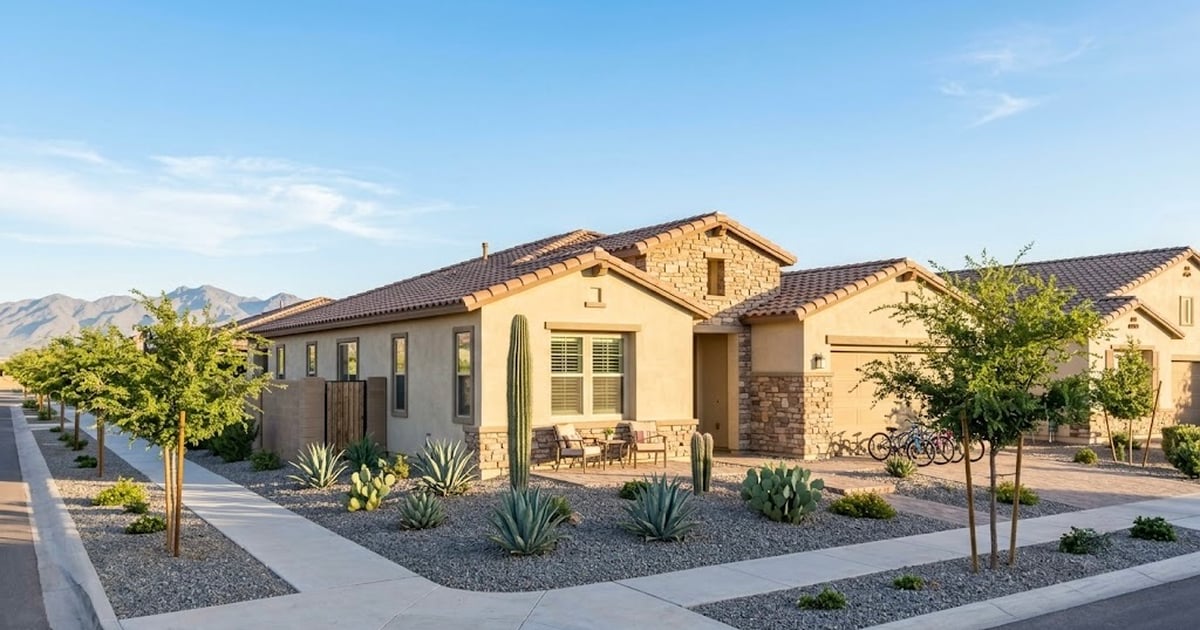
A California couple stands in a model home in North Peoria, AZ. They just sold a house in the Bay Area, they are staring at the price tag on a home with a three-car garage, a pool-sized lot, and mountain views, and one of them says the quiet part out loud: "This is the whole house for less than our old down payment felt like." That reaction is common, and it is also where the mistakes start — because the sticker price is only one piece of what changes when you move from California to Arizona.
You would not be alone in making the move. In 2024, roughly 52,000 Californians relocated to Arizona, the largest single state-to-state flow into the state, according to the U.S. Census Bureau's American Community Survey, with the Phoenix metro as the top landing spot (information deemed reliable but not guaranteed). Here in the West Valley — Peoria, North Peoria, Surprise, Goodyear, Buckeye, Litchfield Park, and the communities around them — a large share of the buyers I meet are coming from somewhere in California. Here is what actually shifts when you buy here, beyond the price.
Your California equity usually stretches further here
The single biggest reason California movers feel relief is the price gap. Comparable homes in the West Valley typically cost a good deal less than similar homes in coastal California metros, which is why buyers arriving with equity from a California sale often find they can move up in size, lot, or finish level while lowering their monthly payment. That is the general pattern, not a promise about any one home.
Two cautions. First, "cheaper than California" is not the same as "cheap" — West Valley prices have their own range by city, community, and price band, and the North Valley Luxe tier runs well into seven figures. Second, prices, inventory, and interest rates change month to month, so the smart move is to verify current numbers for the specific area and home you are considering rather than relying on a headline comparison. What holds up is the direction: for most California sellers, the same budget buys more square footage, more land, and newer construction here than it did back home.
The tax math that surprises most California movers
Income tax is where the difference gets dramatic. Arizona levies a flat 2.5% state income tax on all taxable income — the lowest flat rate in the country — per the Arizona Department of Revenue. California runs a progressive system that tops out at 13.3% on income over $1 million, per the California Franchise Tax Board. For a high-earning household, that gap is not a rounding error; it can be the equivalent of a second mortgage payment freed up every month.
The exact benefit depends entirely on your income and situation, so this is a conversation for your CPA, not a blog. But it is one of the real financial reasons the California-to-Arizona corridor has stayed the busiest western migration route for years, and it is worth understanding before you buy so you can plan your budget around the after-tax picture, not just the purchase price.
How Arizona property tax actually works — and why it is not California
This is the section California movers most often misread, because Arizona's property-tax system does not behave like Proposition 13.
In California, a home is generally reassessed to its market value when you buy it, and increases after that are capped at about 2% a year under Prop 13, with a base rate around 1%. That means two neighbors with identical homes can pay wildly different tax bills depending on when each one bought.
Arizona works differently. Owner-occupied homes (Legal Class 3) are assessed at 10% of the property's Limited Property Value, and under Proposition 117, that Limited Property Value can rise no more than 5% per year, per the Arizona Department of Revenue. Buying the home does not automatically reset your taxable value to the full purchase price the way it does in California. The practical takeaway: Arizona property taxes tend to be moderate and relatively predictable year to year, but the mechanics are different enough that you should not assume your California mental model applies. Ask for the actual tax history on any home you tour, and remember that special districts (like community facilities districts in some newer master-planned areas) can add to the bill.
The climate and lifestyle trade you are actually making
Nobody moves to the West Valley for the weather in July. Summers are genuinely hot, with stretches above 110°F, and the monsoon season runs mid-June through the end of September, bringing dust storms and hard, brief downpours. If your California home was coastal and mild year-round, the summer is a real adjustment, and a good home inspection here pays extra attention to the air-conditioning system for a reason.
The trade you get in return is a Sonoran-desert lifestyle built around the outdoors for the other eight-plus months of the year: backyard pools that actually get used, patios and outdoor kitchens as standard features, hiking and trails near Lake Pleasant, and mild, sunny winters when much of the country is frozen. What Arizona does not have is California's earthquake risk and, in most of the West Valley, the wildfire-in-the-hills exposure that has reshaped insurance in parts of California. It is a different set of trade-offs, not a strictly better one — and knowing which trades matter to your family is part of choosing the right community.
Insurance and hazard profile: another quiet difference
Many California movers have spent the last few years watching home insurance get harder and more expensive because of wildfire exposure. Arizona has its own considerations — heat, monsoon wind and water, and localized flood zones — but the overall homeowners-insurance and natural-hazard picture is different from coastal or foothill California. Do not assume your premium will carry over. Get an insurance quote early in your search on the specific home and area, because it is part of your true monthly cost, and confirm whether a property sits in a designated flood zone before you fall in love with it.
Which West Valley areas California movers tour first
The West Valley is not one place, and the right fit depends on what you are optimizing for — commute, lot size, newness of construction, master-planned amenities, or price. A few anchors, described by what they offer rather than who they are for:
- Peoria and North Peoria, AZ: a mix of established neighborhoods and newer master-planned communities like Vistancia, with golf, trails, and proximity to Lake Pleasant. This corridor is the heart of the North Valley and spans a wide price range up into the luxury tier.
- Surprise, AZ: newer construction and generally more home for the money, with growing retail and its own spring-training stadium.
- Goodyear and Buckeye, AZ: among the fastest-growing cities in the region, heavy on new construction and larger lots, popular with buyers who want a brand-new home and do not mind being farther west.
- Litchfield Park and the Verrado community in Buckeye: tree-lined, amenity-rich, master-planned living with a distinct town-center feel.
Because school boundaries, HOA fees, tax rates, and commute times vary from community to community and can change, verify the specifics for any neighborhood you are seriously considering rather than relying on general impressions.
The relocation logistics nobody warns you about
Buying from 400 miles away has its own choreography. A few things California movers routinely underestimate:
- Timing the two transactions. Selling your California home and buying in Arizona rarely line up perfectly. Options like a buyer contingency, a rent-back, or a short-term rental between homes exist for a reason — decide early whether you are buying before you sell, or selling first and landing your equity before you shop.
- Long-distance and remote closing. Much of a purchase here can be handled remotely with electronic documents and a mobile or traveling notary, so you do not have to be in Arizona for every step. Plan one or two focused trips for touring and inspections rather than assuming you must be here the whole time.
- Establishing residency. Once you move, Arizona expects new residents to obtain an Arizona driver's license and register their vehicles soon after establishing residency. The exact timelines are set by the Arizona MVD and can change, so verify the current requirements at azdot.gov rather than relying on secondhand numbers.
- Registering to vote, updating your address, and switching over utilities are the easy part — but building them into your moving checklist keeps the first month from becoming chaotic.
A quick West Valley example
Picture a couple in their late forties selling a home in the Sacramento suburbs. Back home, their equity felt trapped in a house that had gotten tight and a tax bill that kept climbing. They sell, land the proceeds, and start touring in North Peoria and Surprise. With the same money, they buy a newer, larger single-level home with a pool and a three-car garage, lower their monthly payment, and — because at least one of them still earns strong income remotely — feel the flat Arizona income tax in every paycheck. The adjustment they did not plan for was the July heat and a higher-than-expected AC repair in month two. Nothing fatal, just the trade nobody had told them to budget for. Knowing the trades in advance is the whole difference between a smooth landing and a stressful one.
Ready to plan your California-to-West-Valley move?
Ready to compare your options? Schedule a friendly consultation with Stephanie White so you can build a simple, step-by-step plan for your next move — including how to time your California sale, read Arizona's tax and property-tax rules, and choose the West Valley community that actually fits your life.
Frequently Asked Questions
Is it really cheaper to buy a home in the West Valley than in California?
For most buyers coming from coastal or high-cost California metros, comparable homes in the West Valley typically cost less, which is why California equity often stretches further here. It varies by city, community, and price band, and prices change, so verify current numbers for the specific area and home you are considering.
How much lower is Arizona's income tax than California's?
Arizona uses a flat 2.5% state income tax on taxable income (Arizona Department of Revenue), while California is progressive and tops out at 13.3% on income over $1 million (California Franchise Tax Board). Your actual benefit depends on your income and situation, so confirm the specifics with your tax professional.
Does Arizona property tax work like California's Prop 13?
No. Owner-occupied Arizona homes are assessed at 10% of their Limited Property Value, and Proposition 117 caps annual growth in that value at 5% (Arizona Department of Revenue). Buying the home does not automatically reset your taxable value to the purchase price the way California's reassessment-at-sale generally does. Ask for the actual tax history on any home you tour.
What is the biggest lifestyle adjustment moving from California to Arizona?
Usually the summer heat and the monsoon season from mid-June through September. In exchange, you trade away California's earthquake risk and much of its wildfire-and-insurance pressure, and you gain a Sonoran-desert, outdoor-oriented lifestyle for most of the year. Which trade matters most is personal, so weigh it against what your family values.
Can I buy a home in Arizona without flying back and forth constantly?
Largely, yes. Much of a purchase can be handled remotely with electronic documents and a mobile notary, so many buyers plan just one or two focused trips for touring and inspections. Your agent can coordinate the rest from here.
How soon do I have to get an Arizona license and register my car after moving?
Arizona expects new residents to get an Arizona driver's license and register their vehicles shortly after establishing residency. The exact timelines are set by the Arizona MVD and can change, so verify the current requirements at azdot.gov before you move.
Stephanie White, REALTOR® | Howe Realty Group, LLC
