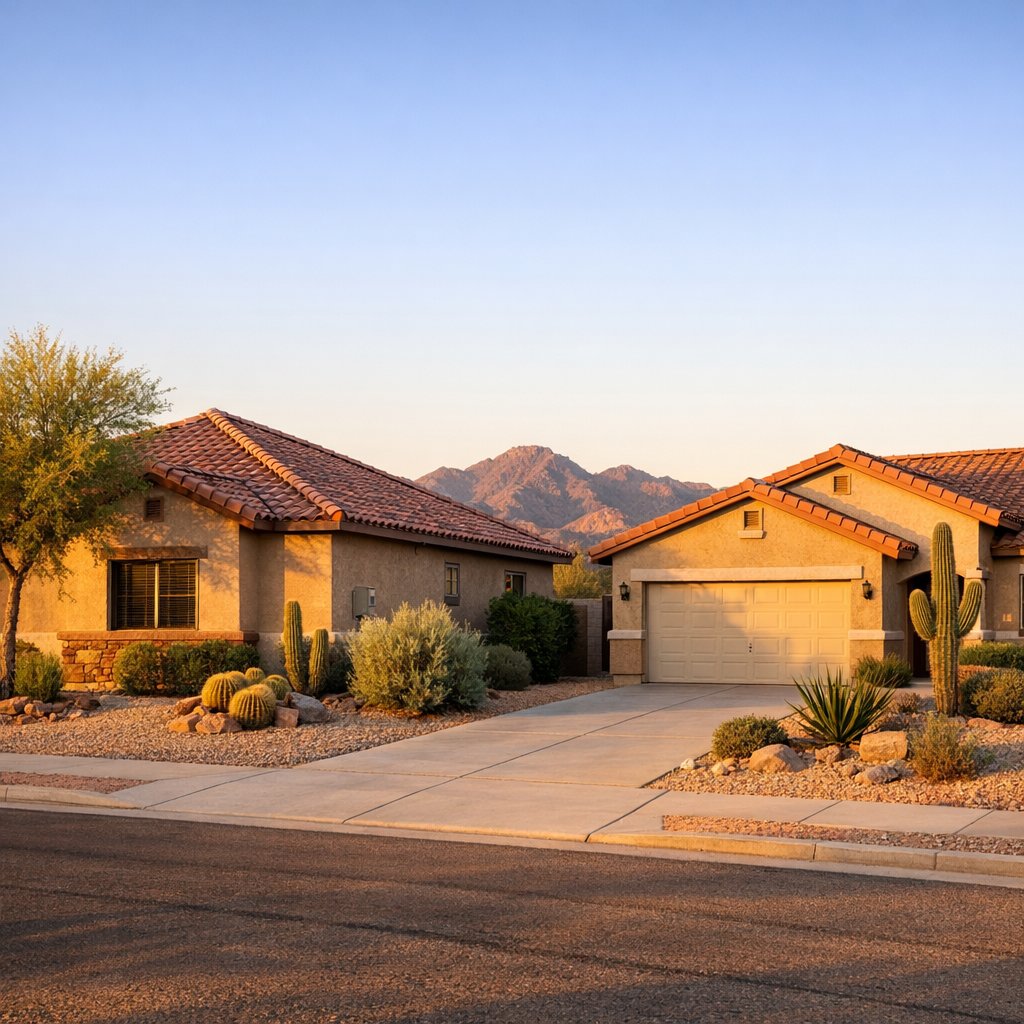
You found two homes you like. Both are four bedrooms, both are around 2,400 square feet, both look great in photos. One is in Peoria, one is in Buckeye, and the prices are tens of thousands of dollars apart. Now you are staring at your screen wondering the same thing almost every West Valley buyer asks me: is the pricier one actually better, or is it just more expensive? This guide walks you through how to compare home value across West Valley communities the way an agent does, so you can stop guessing and start comparing like-for-like. Let's dive in.
Start with price per square foot — then respect its limits
Price per square foot is the fastest way to sanity-check two homes. You take the list price, divide by the finished square footage, and you get a per-foot number you can line up side by side. It is a useful starting filter. It is also one of the most misused numbers in real estate.
Price per square foot flattens everything into one figure, which means it quietly ignores the things that actually make one home worth more than another: the lot, the location within the community, the age, the condition, and the finish level. A smaller home almost always carries a higher price per square foot than a larger one, even in the same neighborhood, because the kitchen, systems, and land get spread across fewer feet. So use it to spot outliers and narrow your list — not to declare a winner.
What actually drives the price gap between communities
When two comparable homes are priced differently across West Valley cities, the difference usually traces back to a handful of specific factors. Here is where to look.
Lot size and lot position
Two identical floor plans can differ by a real margin based on the dirt they sit on. A north-south exposure, a larger or premium lot, a cul-de-sac, or a mountain or open-space view often commands more than an interior lot backing to another home. In newer communities, that difference started as a builder lot premium and it tends to follow the home into resale.
Age, condition, and the expensive systems
A ten-year-old home and a brand-new home can look similar online and cost very differently to own. Roof age, HVAC age, water heater, and whether the home has had its first round of updates all move value. In our climate, air conditioning and roof condition matter more than buyers from cooler states expect, because summer runs them hard.
Finishes, upgrades, and what the previous owner actually paid for
Two homes with the same square footage can sit a full tier apart on finishes: quartz versus laminate, tile versus carpet, a finished backyard with pavers and a pool versus bare gravel, owned solar versus none, extended garages, casitas, or a designer kitchen. Builder upgrades and post-close improvements are where a lot of the "why is this one more" answer lives.
New build versus resale
A new build in an active community may price above a similar resale a few miles away because you are buying current finishes, full builder warranties, and no deferred maintenance. A resale may price below it but come with a mature yard, established landscaping, window coverings, and no wait — things a new build makes you add later. Neither is automatically the better value; they are different trade-offs.
The ownership costs that change the real price
The sticker price is only part of what a home costs you. Two homes at the same price can have very different monthly realities once you add the recurring costs, and these are where cross-community comparisons trip buyers up the most.
HOA fees and amenity tiers
West Valley HOA dues range widely. A gated, resort-style master plan with golf, multiple pools, and staffed amenities carries higher and sometimes layered dues; a simpler community may charge a fraction of that. Higher dues are not automatically bad — you may be buying real amenities — but they change your true monthly cost, so compare them directly. HOA fees, rules, and restrictions should be reviewed in the community's current documents before you rely on them.
Community Facilities District (CFD) assessments
This is the one out-of-state and first-time buyers miss most. Many newer West Valley communities in Buckeye, Goodyear, and Peoria were built inside a Community Facilities District — a special taxing district that helped finance the roads, water, and infrastructure for that specific area. If a home sits in a CFD, you pay an additional assessment on top of your regular property taxes, and that rate can change year to year depending on the district's debt service. Two otherwise identical homes can have meaningfully different tax bills purely because one is inside a CFD and one is not. You can confirm whether a community has a CFD directly with the city's finance department. (Information deemed reliable but not guaranteed; verify current district status and rates for the specific property.)
Property taxes and insurance
Base property tax rates vary by city and district, and insurance can vary by home age, roof, and features. These are property-specific numbers, so pull the real figures for each home rather than assuming they match.
How to build a real apples-to-apples comparison
Once you know what moves value, you can put two homes on equal footing. Use this checklist before you decide one is overpriced.
- Confirm the real square footage from the county record, not just the listing.
- Compare lot size and lot position, including premiums for views, corner, or cul-de-sac.
- Note the age and condition of roof, HVAC, water heater, and major systems.
- List the finish and upgrade gaps: flooring, counters, backyard, pool, solar, garage, casita.
- Add the recurring costs: HOA dues, any CFD assessment, property tax rate, insurance estimate.
- Check location within the community: proximity to arterial roads, Loop 303, Loop 101, I-10, or US-60, and to shopping, healthcare, and parks.
- Pull recent comparable sales in each community — closed sales, not just active list prices.
- Re-run price per square foot only after you have adjusted for the items above.
When you do this, the "expensive" home often turns out to be either clearly justified or clearly not — and the number that felt confusing at the start becomes a decision you can actually defend.
A quick local example
Picture a couple relocating for work and cross-shopping two homes around 2,400 square feet. The first is a resale in an established Peoria neighborhood: mature landscaping, a finished backyard, no CFD, moderate HOA dues, and a roof and AC that are several years in. The second is a newer build in a growing Buckeye community: current finishes, full warranties, a bare backyard, and — importantly — a CFD assessment on top of taxes plus higher introductory HOA dues. On price per square foot alone, the Buckeye home looked like the "better deal." Once they added the CFD assessment, the cost to finish the yard, and the higher dues, the two homes were far closer than the sticker prices suggested — and the decision came down to lifestyle and commute, not a spreadsheet. That is the point of comparing this way: it turns a confusing price gap into a clear trade-off.
When price per square foot will mislead you
A few situations reliably break the per-foot shortcut. Small homes will look "expensive" per foot next to larger ones. A heavily upgraded home will look expensive next to a builder-basic one of the same size. A home on a premium view lot will look expensive next to an interior lot. And a home inside a CFD will look cheaper on price but cost more to own. In each case the raw number is telling you something real is different — your job is to find out what, not to assume the higher number is a rip-off or the lower one a steal.
Because prices, inventory, school boundaries, HOA fees, taxes, and commute times can change, verify the details for the specific property you are considering.
Ready to compare your options?
Schedule a friendly consultation with Stephanie White so you can build a simple, step-by-step plan for your next move — including a real, community-by-community comparison of the homes you are weighing.
Frequently asked questions
Why are homes in one West Valley city more expensive than a similar home in another?
Usually it comes down to lot, location within the community, age and condition, finish level, and recurring costs like HOA and CFD assessments. Two homes that look alike online can differ on several of those at once, which is why the prices diverge.
Is price per square foot a reliable way to compare homes?
It is a good first filter and a poor final answer. It ignores lot, condition, upgrades, and ownership costs, and it naturally runs higher on smaller homes. Use it to narrow your list, then adjust for the real differences.
What is a CFD and how does it affect what I pay?
A Community Facilities District is a special taxing district that financed infrastructure for a specific community. If your home is inside one, you pay an assessment on top of regular property taxes, and the rate can change year to year. Confirm current CFD status and rates with the city's finance department for the exact property.
How do HOA fees factor into comparing two homes?
Higher dues can reflect more amenities, so they are not automatically a negative — but they change your true monthly cost. Compare dues directly and review the current community documents for what the fee includes and any restrictions.
Should I choose a new build or a resale to get better value?
Neither is automatically better value. A new build offers current finishes and warranties but often a bare yard and possible CFD; a resale may cost less and include mature landscaping and window coverings but carry older systems. Compare the full picture, not the headline price.
How do I know if a home is actually overpriced?
Adjust for lot, condition, upgrades, and recurring costs, then compare against recent closed sales — not active list prices — in that community. If it still stands out after those adjustments, it may be priced high; often it is simply a better home.
Can commute location really change a home's price?
Yes. Proximity to major corridors like Loop 303, Loop 101, I-10, and US-60, and to shopping, healthcare, and parks, affects desirability and price. Commute times are property-specific, so check them for your own routine before deciding.
